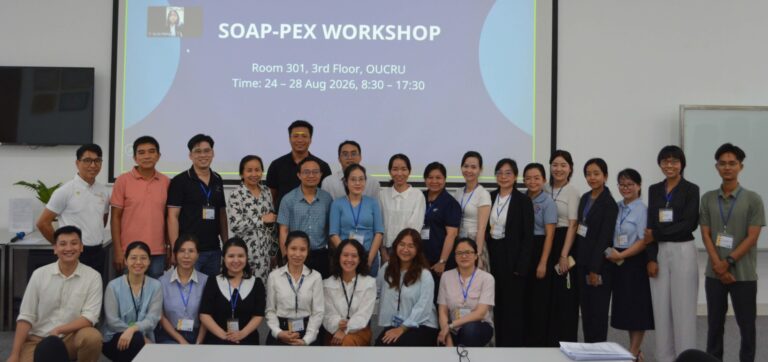


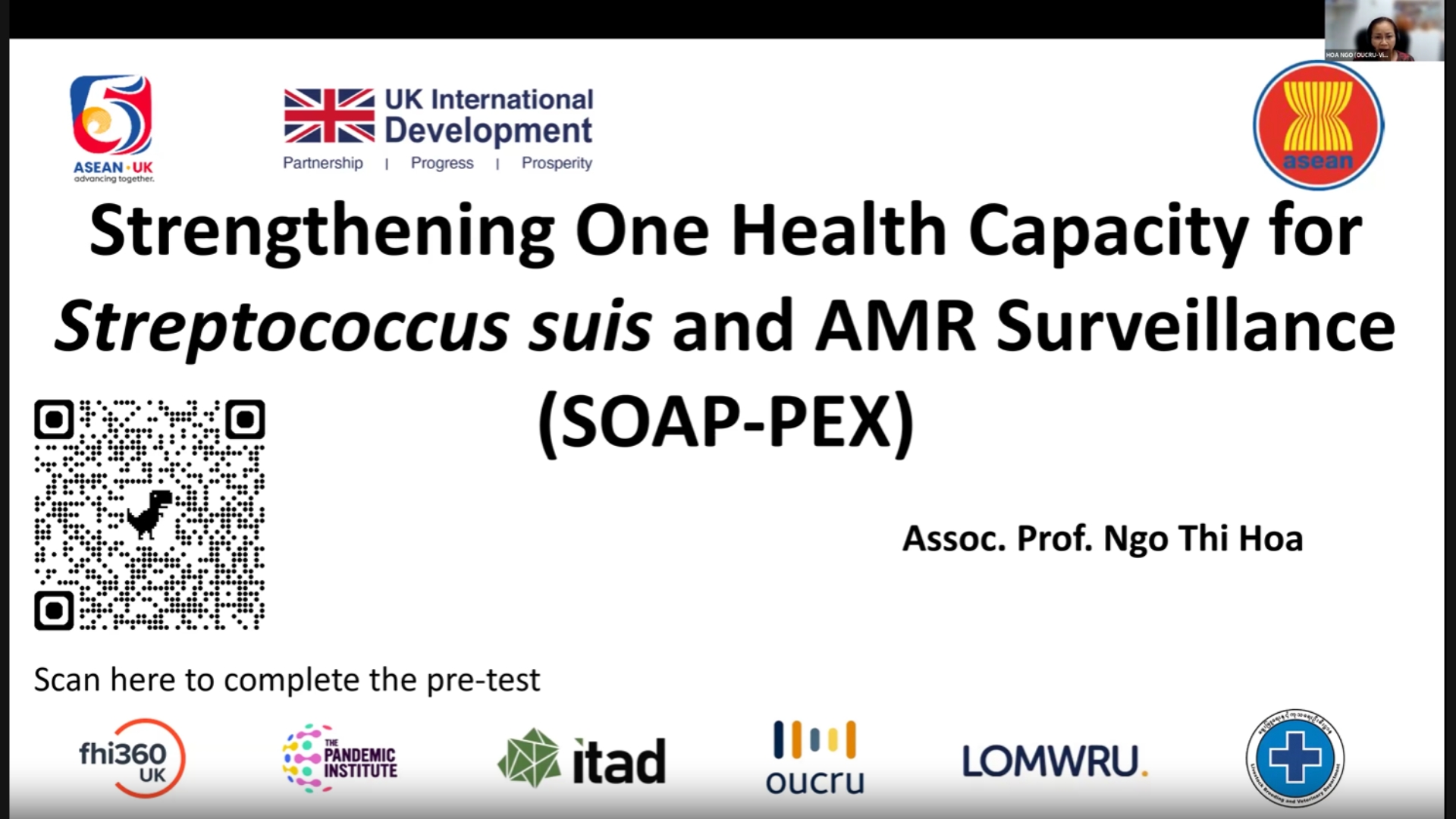
These questions were at the centre of the first webinar in the SOAP-PEX regional training series, Foundations, Ethics, and Data Governance in One Health and AMR Research, held on 22 September 2026.
The virtual session brought together researchers, epidemiologists, microbiologists and public health practitioners from across Southeast Asia, including Vietnam, Indonesia, Laos, Myanmar and Malaysia. Speakers and participants explored the ethical, data governance and policy considerations that underpin responsible AMR and One Health research.
Ethics continues throughout the research process
Opening the webinar, Dr. Vu Thi Lan Huong from Oxford University Clinical Research Unit (OUCRU) focused on the practical challenges of conducting ethical research in One Health settings.

She emphasised that research ethics goes beyond obtaining a signed consent form. Informed consent should be understood as an ongoing process, with participants clearly understanding the purpose of a study, how their data will be used, potential risks, and their right to withdraw without penalty.
Data protection presents another important challenge. Removing direct identifiers such as names does not necessarily make research data anonymous. When information such as age, farm location, animal species and laboratory results are combined, individuals or farms may still be identifiable.
In some settings, this could have consequences beyond privacy. Information linked to a particular farm or community could potentially affect a farmer’s reputation or livelihood.
For this reason, responsible data governance needs to be considered across the entire data life cycle, from collection and linkage through to storage, access, sharing and secondary use. Researchers need to be able to answer four basic questions at each stage: Who is using the data, what data are being used, why they are being used, and how they will be protected.
Connecting research with the global AMR response
The second presentation, by Dr. Hnin Thidar Myint, Co-PI of the SOAP-PEX project, placed these research and governance questions within the broader global response to AMR.
AMR is expected to have significant consequences for human health, economies and food systems without effective intervention. Addressing the challenge therefore requires coordinated action across sectors and countries.
Dr. Hnin Thidar Myint highlighted the role of the Quadripartite organisations — the World Health Organization (WHO), Food and Agriculture Organization of the United Nations (FAO), World Organisation for Animal Health (WOAH) and United Nations Environment Programme (UNEP) — in advancing a coordinated One Health response.
She also discussed the updated Global Action Plan on AMR for 2026–2036, adopted at the 79th World Health Assembly. The plan sets out six strategic objectives covering areas including awareness, surveillance, infection prevention, equitable access to diagnostics and vaccines, research and innovation, and sustainable multisectoral governance.
At the national and regional levels, these global commitments need to be translated into action through well-supported National Action Plans and coordinated One Health approaches. For Southeast Asia, regional frameworks such as the ASEAN Strategic Framework on AMR provide an important basis for strengthening collaboration across countries and sectors.
From national commitments to local action
The discussion continued during an interactive Q&A, where participants raised practical questions about how these principles can be applied in research settings.
One discussion focused on providing treatment access or financial support to research participants. Participants considered how researchers can ensure that such support does not create undue influence on participation. Dr. Lan Huong highlighted the role of institutional ethics committees in reviewing appropriate forms and levels of compensation.
Another discussion addressed a broader implementation challenge: how to translate national and international One Health commitments into action at the local level.
Participants noted that coordination can be more difficult when high-level ministerial structures are not closely connected to provincial implementation. Joint provincial action plans involving health and agriculture authorities were discussed as one potential way to strengthen coordination and bring One Health approaches closer to where research and public health interventions take place.
Building a stronger foundation for One Health research
The first SOAP-PEX webinar highlighted that responsible AMR research is not only about producing high-quality scientific evidence. It also requires researchers to think carefully about the people and communities involved, the data generated, and the systems through which evidence is translated into policy and practice.
By bringing together perspectives on research ethics, data governance and global AMR policy, the webinar provided a foundation for the wider SOAP-PEX training series and for continued discussion on how One Health research can be conducted responsibly and contribute to meaningful action across the region.