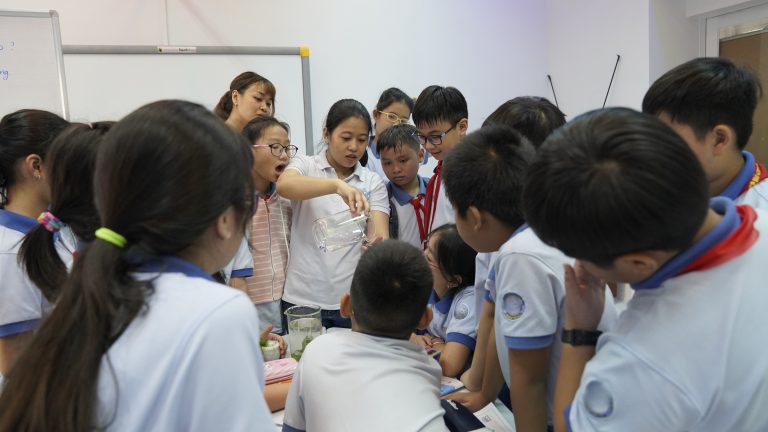
Chat with Scientists was the first online interactive event in Vietnam to connect middle school students with scientists. Students can discuss with scientists, challenge them with fun questions following three themes, engage in online conversations about science topics, and vote for their favorites to win the School Science Award.

Key Activities

Scientists

During the project, scientists uploaded their profiles to the project’s webpage, answered students’ questions related to their scientific fields, and participating in dialogues with students during online chat sessions.

By participating in the event, besides the “challenge” of communicating science to young people, scientists also have the opportunity to better understand the perspective of today’s youth regarding science and the role of scientists.

Favorite scientists, chosen by participating students, would won the School Science Award, which could be used to organise other scientific activities for students.


Teachers

As the format of the project was an interactive contest between scientists with participating students were judges, teachers could help in many ways such as:

  • Guide students to learn about scientists’ work through “profiles” posted on the project’s website
  • Help students develop criteria for selecting scientists
  • Support students to participate in project activities most effectively through specialised instructional materials developed for teachers
  • Guide students in asking questions and chatting online with scientists about specific topics

Discussion Topics

Infectious Diseases

Microorganisms are all around us—while most are harmless, some cause severe diseases like dengue, flu, or tuberculosis. In this section, you will connect directly with scientists studying these microscopic organisms. Explore the causes behind infectious diseases, learn effective prevention strategies, and dive into unanswered medical mysteries.


Q: Does hot weather make it easier for infectious diseases to spread?

A by Dr Nguyễn Minh Nguyệt: Yes. Hot weather creates ideal conditions for disease outbreaks through insect vectors, as well as for eye and digestive, respiratory and contact diseases.  

Animals

Ever wondered “Why are whales mammals if they live underwater?” or “Between a lion and a tiger, who would win?” From Darwin’s theory of evolution to animal behaviours, the topic Animal unveils the wonders of the natural world.

Q: Why do flamingos stand on one leg? Doesn’t it tire them out?

A by Nguyễn Thị Ánh Minh: Scientists are still searching for the exact answer, but there are two main theories:

  • Body Temperature Control: Standing on one leg reduces heat loss while standing in cold water.
  • Energy Conservation: Research shows standing on one leg requires no active muscle effort. In fact, tests on flamingo cadavers revealed that balancing on one leg is effortless and uses less energy than standing on two legs.

Infectious Diseases

Microorganisms are all around us—while most are harmless, some cause severe diseases like dengue, flu, or tuberculosis. In this section, you will connect directly with scientists studying these microscopic organisms. Explore the causes behind infectious diseases, learn effective prevention strategies, and dive into unanswered medical mysteries.

Q: Does hot weather make it easier for infectious diseases to spread?

A: Yes. Hot weather creates ideal conditions for disease outbreaks through insect vectors, as well as for eye and digestive, respiratory and contact diseases.  

Microorganisms are tiny living things invisible to the naked eye yet always present around us. Despite their size, they significantly impact our lives – mostly beneficial, though some may spread terrifying diseases and cause global pandemics.

In this Harmful Microorganisms topic, 5 scientists would help students to identify the culprits behind stomach aches or diarrhea while exploring this mysterious microscopic world.

Q: Does E. coli bacteria live in our bodies before causing disease?

A: E. coli bacteria are found in many places; they are commonly present in food (especially undercooked items) and water sources (particularly contaminated ones), and they also colonize the human large intestine…

Q: How long do microorganisms live?

A: Like all other living organisms, microorganisms are born, grow, and die. Bacterial reproductive cycles are often very short—measured in minutes or hours; for instance, E. coli undergoes cell division every 15 minutes…

Questions like “Why are whales mammals but live in water?” or common argument “Between lions and tigers, which is stronger?” would be explored in the Animals topic.

Students would chat with scientists who studied different animal species, ranging from birds, reptiles and amphibians, frogs, insects (especially butterflies), veterinary, and primatology.

Did you know that “science” comes from the Latin word “Scientia,” consisting of knowledge gained through practical experience, research, and testing hypotheses based on evidence and experiments?

In the Scientific Research topic, five scientists working in different research areas would help students learn more about what scientific research involves and what qualities make a good researcher. Students could even develop ideas for their own research project!

Featured Questions

Loading...

Partnered scientists

LEARN MORE

Related

Skip to content