


Connecting Health, Climate and Justice to Tackle AMR
6 February 2026
The final global convening meeting of the “Just Transitions for AMR” group was hosted at the Tropical Agricultural Research and Higher Education Centre (CATIE) in Costa Rica, from 26 to 29 January 2026.
The event included a dialogue session that brought together researchers, civil society and institutional leaders to explore antimicrobial resistance (AMR) through the intersecting lenses of justice, environmental sustainability and climate action.
The event highlighted the need for integrated, equitable responses that connect health, the environment, and community participation, moving from awareness to action to build resilient and fair approaches to AMR globally. Find out more about the dialogue event and the rest of the convening.
Communicating for Change: Rethinking how AMR is discussed with society
20 January 2026
On 4 November 2027, 47 researchers, science communicators, and artists from Europe, Africa, Asia, and Latin America gathered at the British Academy’s London offices for a full-day symposium exploring the social justice perspectives of public communication and engagement around AMR. The event formed part of the Just Transitions for Antimicrobial Resistance (JT4AMR) global convening and focused on how antimicrobial resistance (AMR) is communicated across diverse social and cultural contexts.
Delegates explored how communication practices shape public understanding of AMR, influence behaviour, and intersect with broader questions of equity, power and justice. A central theme across the discussions was the need to move beyond awareness-raising approaches. Speakers highlighted growing evidence that simply increasing public knowledge of AMR is insufficient to drive meaningful change. Instead, more dialogical, participatory and context-sensitive forms of communication are needed, including approaches that recognise lived experience, local knowledge and the social conditions shaping antibiotic use.
Sessions addressed AMR communication across diverse societal settings, examined how metaphors and framing shape risk perception, and showcased creative, arts-based engagement methods. Storytelling, theatre, cartoons, exhibitions and playful learning were presented as powerful ways to open new conversations about AMR that resonate beyond technical or biomedical narratives. Issues of justice and decolonisation featured prominently. Contributors emphasised that AMR communication cannot be separated from historical and structural inequalities, particularly in global health. Co-creation with communities, attention to language and culture, and an explicit focus on power relations were identified as essential to supporting more just transitions in addressing AMR.
The symposium concluded by reaffirming the importance of treating AMR not only as a biomedical challenge but also as a social one. Participants will be invited to contribute to an upcoming special issue of the Journal of Science Communication on AMR communication, helping to extend the impact of the discussions beyond the event.
Poster Presentation at International AMR and Genomics Conference 2025 in Malaysia
November 2025
Dr. Lamisa Rahman, Senior Research Associate at the Centre of Excellence for Health Systems and Universal Health Coverage (CoE-HS&UHC), presented a poster titled “A Just Transitions Framework for Equitable Antimicrobial Resistance Containment: Insights from Five Deliberative Community Workshops in Bangladesh” at the International Conference on Antimicrobial Resistance (AMR) and Genomics 2025, held at Monash University Malaysia in November 2025.
As a member of the project team contributing to the JT4AMR project at CoE-HS&UHC, Dr Rahman has helped to organise nine stakeholder workshops in Bangladesh, engaging participants across multiple levels, from national policymakers to grassroots actors, including formal and informal healthcare providers and representatives from the livestock, agriculture, and poultry sectors.
The poster showcased findings from deliberative community workshops conducted in Bangladesh under the British Academy-funded JT4AMR project. The presentation highlighted community perspectives on equity, justice, and the feasibility of AMR mitigation strategies in low- and middle-income countries. The session facilitated engagement with international researchers and practitioners working at the intersection of AMR, genomics, health systems, and social justice, contributing to broader cross-disciplinary dialogue on just transitions for AMR containment.
Tess Johnson reflects on her participation in the 2025 Oxford Global Health and Bioethics Conference
8 July 2025
Several members of the “Just Transitions for AMR” global convening participated in a panel discussion at the 2025 Oxford Global Health and Bioethics International Conference, held on 8–9 July 2025 at the Mathematics Institute, University of Oxford. Among them, Dr Tess Johnson co-presented a talk (with fellow convening member Professor Phaik Yeong Cheah) titled ‘A Just War on Bugs? Ethical Differences Between Antimalarial Resistance and Antibacterial Resistance’.
“It was rewarding to receive feedback from an academic audience on this work, which originated from the Global Convening Programme’s meetings,” Tess reflected afterwards.
“We have been discussing antimalarial resistance since our convening meeting in Bangkok a few years ago. In particular, Phaik Yeong and I have been considering whether differences between pathogens might influence how we prioritise research and interventions to combat AMR. We believe that antimalarial resistance warrants greater prioritisation than it currently attracts. It was encouraging to hear both support for this view and challenges, particularly regarding the feasibility and appropriateness of eradicating malaria. This feedback will inform our subsequent revisions of a paper, which is currently under review at a leading journal.”
Just Transitions for AMR working group presents at the Oxford Global Health and Bioethics International Conference 2025
8 July 2025
On 8 July 2025, the Just Transitions for AMR Working Group organised a 75-minute panel discussion at the Oxford Global Health and Bioethics International Conference held at the University of Oxford, UK. The aim of the panel was to gather feedback on the strengths and limitations of our approach, identify any gaps, and explore areas for further work. The panel was chaired by Phaik Yeong Cheah (Mahidol Oxford Tropical Medicine Research Unit, Thailand), who introduced the topic. This was followed by a series of six five-minute presentations by members of the working group.
Sonia Lewycka (Oxford University Clinical Research Unit, Vietnam) explained the origins and development of the Just Transitions approach and its application in the context of antimicrobial resistance (AMR). Sonia described how we are adapting the “just transitions” concept, which is used in climate change mitigation, to promote fair and equitable policy shifts toward sustainable, low-carbon economies. She highlighted parallels between climate change and AMR: both are “super-wicked” problems, both disproportionately impact disadvantaged populations, and both require collective action.
Tess Johnson (Ethox Centre) discussed various conceptions of justice being considered by the group in relation to AMR, and noted forms of justice often overlooked by traditional Just Transitions frameworks, such as epistemic justice and ubuntujustice.
Deepshika Batheja (Indian School of Business and One Health Trust, India) illustrated how AMR affects different populations unequally, including disparities between men and women and among different caste groups in India.
Duy Minh Vu (Oxford University Clinical Research Unit, Vietnam) shared insights from a project in Vietnam in which his team engaged primary care doctors, healthcare stakeholders, and community members to explore their views on AMR.
Edna Mutua (KEMRI-Wellcome Trust, Kenya) presented an overview of policies surrounding AMR containment in low- and middle-income countries and illustrated gaps in governance mechanisms – most of which are adapted from the Global Action Plan and implemented in a top-down manner.
Finally, Sheila Varadan (University of Leiden, the Netherlands) drew connections between Just Transitions for AMR and climate justice, summarised key points from the panel, and highlighted important gaps in the current Just Transitions framework.
The session concluded with a Q&A segment. Participants raised questions about the practical implementation of the framework and whether different approaches should be considered for different microbes and pathogens.
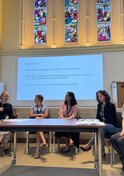
Social conversations about bugs and drugs at the BA Summer Showcase
24 June 2025
‘Bugs and drugs’ were featured on the menu at the 2025 Summer Showcase of the British Academy, with four members of the ‘Just Transitions for Antimicrobial Resistance’ (AMR) working group leading a science café on 21 June. Nearly 30 members of the public gathered for an open conversation about antibiotics, ethics, and the future of healthcare.
“I found the discussion fascinating, especially the debate about equity in healthcare,” said computer scientist Anthony Kesterton. “I never realised how interconnected the use of antibiotics is to so many aspects of our lives.” (Anthony also captured the featured photo of the British Academy during the event.)
Discussion points ranged from antibiotic use in farming, the influence of ‘big pharma’ in encouraging overuse and the role of ‘good’ versus ‘bad’ bugs. “It was interesting to hear people’s views on the connections between antibiotic drugs and our modern lives and systems, and what drug resistance means for our relationships with microbes. This included the ‘should we have more dirt in childhood?’ debate, and how porous boundaries should be, such as nurses and surgeons wearing scrubs to cafes near to their hospitals”, Professor Clare Chandler remarked.
Professor Caesar Atuire highlighted some of the key tensions between public health ideals and global economic pressures, such as the desire to farm less intensively and how it contrasts with growing demands on food production. He also highlighted the ethical challenges of donating near-expired drugs to developing countries.
For Professor Sonia Lewycka, who leads the ‘Just Transitions for AMR’ project, one conversation stood out: Some people spoke about using as little medicine as possible, while others described using medicines regularly to stay well. “The first perspective made me think of the Hippocratic belief in the natural ability of the body to heal itself, while the second perspective reminded me of conversations about traditional medicine in Vietnam, where, based on Confucian principles, medicines are used to keep the body in balance.” This conversation provided me with some good ideas about how to explore the use of antibiotics in Vietnam further, she added.
“I found the event useful as a way to reflect on my communication of some of my work,” Dr Tess Johnson remarked. “Sometimes, particularly as an ethicist, you get wrapped up in the details of an argument or the specifics of a case, and it’s hard to take a step back and see the big picture of what you’re trying to do. An event like this is a valuable reality check about people’s concerns and the ethical issues they care about. I am reminded of why we’re undertaking this research and where my priorities should lie.”
Johnson brought along a World Health Organisation (WHO) poster showing a hand reaching into a bowl of sweets mixed with antibiotics. While some attendees saw the image as a call for greater access to antibiotics, others viewed it as a warning against their misuse. The differing interpretations sparked reflection among the facilitators. “This example illustrates why it’s essential to pre-test health communication materials with your audience,” added Professor Marina Joubert. “People may read a message very differently from what the scientists or designers intended.”

Learning Across Crises: Reflections from the “AMR and Transitional Justice” Workshop at the University of Graz
6 June 2025
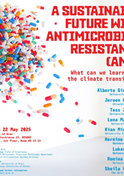
From 21–22 May 2025, three members of the BA-funded Just Transitions for AMR Working Group (Professor Sonia Lewycka; Dr Sheila Varadan and Dr Tess Johnson) participated in a two-day interdisciplinary workshop titled “AMR and Transitional Justice: What Can We Learn from the Climate Transition?” Hosted by the University of Graz, the event was part of the Austrian Science Fund (FWF) project: A Political Conception of Transitional Justiceand supported by Climate Change Graz.
The workshop brought together scholars and practitioners to explore how insights from climate justice can inform approaches to justice in transitions, particularly in the context of antimicrobial resistance (AMR). By examining the parallels between AMR and climate change, participants considered how justice frameworks might support more equitable and inclusive transitions.
The Just Transitions for AMR Working Group was invited to share its expertise on how the just transitions framework can address the trade-offs and unequal burdens associated with AMR and related interventions.
Professor Sonia Lewycka presented on epistemic injustice in AMR research, highlighting how certain groups are unfairly marginalised in the production, dissemination, and application of AMR knowledge.
Dr Sheila Varadan discussed the dual nature of just transitions in AMR, emphasising both the potential to promote sustainability and equity, and the challenges posed by competing priorities, power imbalances, and global inequalities in AMR governance.
Dr Tess Johnson examined the ethical justifications presented for coercive antimicrobial stewardship measures. She argued in favour of more structured analysis of potential justifications and their theoretical and empirical foundations before justifications like ‘this measure will promote solidarity’ or ‘this measure holds those responsible for antimicrobial resistance accountable’ are presented to publics by policymakers.
Participants left the workshop with a deeper and more nuanced understanding of justice, drawing on transitional justice concepts from the climate change field. These perspectives offer valuable tools for addressing the complex challenges of just transitions in AMR. A key theme that emerged was the importance of language – particularly the term epistemic injustice – in shaping how injustice is identified and addressed. This reflection is expected to influence future research and writing in the field.
The workshop not only enriched the intellectual foundation of the Just Transitions for AMR initiative but also opened new avenues for collaboration and partnership. It provided a productive space for reimagining how we understand and respond to the global challenge of AMR.
Breaking Barriers in AMR Communication: Insights from PCST2025
3 June 2025
Public communication and engagement around antimicrobial resistance (AMR) was on the agenda at the 2025 Public Communication of Science and Technology (PCST) Conference, held from 24–27 May in Aberdeen, Scotland. A panel titled “Breaking Barriers: Refocusing Public Communication about AMR” brought together international experts to explore innovative strategies for addressing this global health challenge.
Convened by Marina Joubert (Stellenbosch University, South Africa), a member of the ‘Just Transitions for AMR’ working group, the panel featured diverse perspectives on the complexities of AMR communication.
Marina Joubert opened the session with findings from a scoping review that identified key challenges and potential solutions in AMR communication. Brigitte Gschmeidler (Life Sciences in Dialogue, Austria) emphasised the importance of regional context in shaping effective AMR messaging. Mary Chambers (Oxford University, Vietnam) explored how decolonising science communication can address the “super-wicked” nature of AMR in Southeast Asia. Paul Flowers (University of Strathclyde, UK) discussed strategies for fostering meaningful public engagement on AMR.
Katharine Richter (University of Adelaide, Australia) showcased how public events like Pint of Science, Soapbox Science, and National Science Week are used to connect Australian audiences with AMR research. Bruno Pinto (Agência Nacional para a Cultura Científica e Tecnológica, Portugal) concluded the session with a creative look at how comics can serve as powerful tools for AMR communication.
The panel sparked lively discussion, guided by four thought-provoking questions:
1. How can we overcome the ‘language’ and ‘image’ problem of ‘antimicrobial resistance’?
2. When should culture and local knowledge be embraced in science communication—and when might they pose challenges?
3. What evidence base can we build for effective public engagement on AMR?
4. Can storytelling enhance our ability to communicate AMR?
Stay Connected: To stay informed about future events or research related to AMR communication, contact Marina Joubert at marinajoubert@sun.ac.za